Saturday, May 11, 2013

FAIRY GARDENS AND THE MAGIC OF SHINING


Fairy gardens were a topic of discussion at last week’s magical chat session, so I want to expand on some of the things we talked about.  Because a lot of fairies are attracted to things that sparkle, it is fun to work shiny objects into your garden décor.  One idea is to tie beads to the branches of a favorite bush or small tree.  Note that the Pomo Indians of California gave beads as offerings to nature spirits.  (I’d have to check my sources, but I think sometimes they’d scatter the beads, and sometimes they’d tie a thong with a few beads on it to the limb of a tree.)  Some Eastern woodland Indians referred to beads as “Manitou berries."

Of course, many common items of garden décor, such as twirlers, sun catchers, wind chimes, and wind mills incorporate shiny features.  Those large garden balls, called gazing globes or reflecting globes, are said to enhance a garden’s fertility by reflecting multiple images of its vegetation.  I think they go back to the Renaissance, and although their intent may have originally been purely decorative, the magical applications were quickly recognized.

Shiny objects also bring “the flash of spirit” into your garden.  This is an important feature of African-American “yard shows” (and grave decorations), because it acknowledges the world of spiritual power, while also invoking its protective influences.  (Refer to Robert Farris Thompson’s book, “The Flash of Spirit.”)  I get into some of these concepts in my magical chat for July, when we explore “The Magic of Shining.”  Shining/sparkling qualities are often characteristic of glamour bombs, which are performative art objects created to re-instill the world with a sense of possibility in fairy magic.

Speaking of performative actions, to delight the fairies, you could think about putting on some sort of music or dance or other type of performance while you’re spending time in your fairy garden, because as the naturalist poet Gary Snyder has observed, “Performance is currency in the Deep World’s Gift Economy.”  Anthropologists apply the term “gift economy” to certain gift giving traditions and exchanges within certain types of cultures: in a gift economy, one doesn’t expect immediate reciprocity, yet there is an understanding that the gift creates a bond, and can also be part of a cycle of exchanges (paying it forward) that generate over-all well being.

The Deep World includes spiritual and metaphysical entities and forces, as well as the denizens of Nature, and one can cite numerous cultural practices of putting on performances to honor these beings.  For example, after a major hunt, some Native American groups will honor the spirit of the animal by putting on a song, dance, and masquerade performance.  However, they will also often put on performances for the Animal World and the Spirit World just because it’s the neighborly thing to do.  If we look at the lore of fairies, we find they are also deeply appreciative of performance.

Saturday, May 4, 2013

FAIRY MAGIC FOR BELTANE


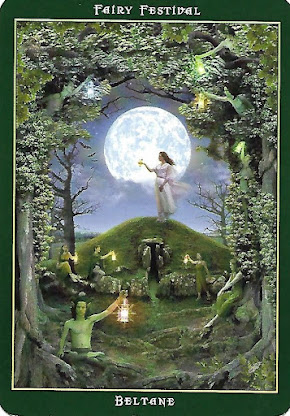
Hi all!  I will be back at the Triple Goddess tomorrow to demonstrate some uses for fairy cards, in honor of the great fairy festival of Beltane.  In the meantime, I’ve been thinking about ways that we can enjoy a good relationship with the fairy folk.

When we look at the role the fairies play in so many different cultural traditions, we see that the fairies’ activities raise the vital energy that enlivens the universe.  Or maybe I should say, “multiverse.”  Actually, I like the Buddhist convention of talking in terms of “the ten thousand world systems.”  When viewed from that perspective, there can also be many different types of fairy realms, and other realms that can feel the influence of fairy magic.
 
So, if so much of fairy magic is spreading well being, what can we do to generate some good energy to keep the fairies going?  Well, traditionally, some of the most basic things are 1) acknowledging the fairies and their good work through greetings and ritual, 2) setting out suitable offerings, 3) creating beauty--as beautiful words, gestures, things, and places give fairies delight, and 4) engaging in celebrational activities, because festive energies revitalize fairy life.  Of course, in planning your celebrations, be sure to acknowledge the fairies by inviting their participation, set out foodstuffs such as miniature sweets or pour libations in their honor, and be creative about ways to bring beauty and grace into the festivities.

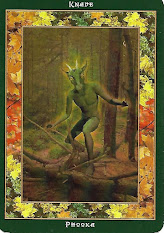
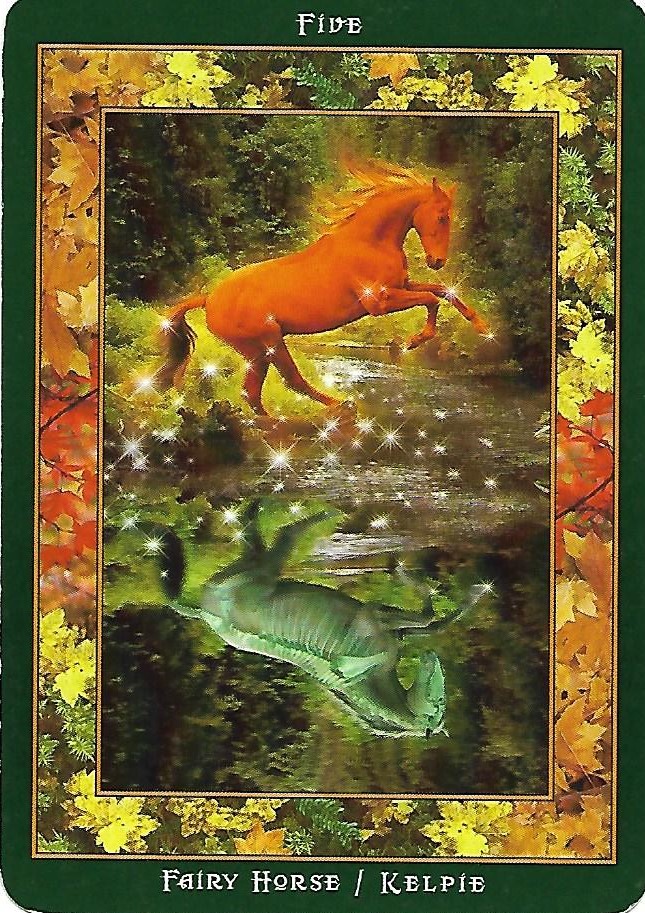
Of course, working with the different fairy decks is another way of acknowledging fairies.  So, now I have something personal to relate.  After drafting the above three paragraphs, I got up to read some fairy cards for myself, as I am about to go out on a walk, and wanted something to muse over, as well as some fairy companions to accompany me.  Well, seconds after pulling cards from assorted decks—and I’m talking seconds, because I don’t think even a minute had passed—I found my little gold mano cornuta necklace & pendant, which I have been looking for for two weeks, and had given up for lost, figuring it had fallen off during one of my walks.  I think the little folk are trying to tell me something, in affirming their existence.  Incidentally, some of the cards I drew were the Brownie from the Mason-Franklin “Fairy Ring” deck, and “Gawtcha,” a fairy type that catches you unawares, from the Froud “Faeries Oracle.”   So, one of my errands today will be to buy a fancy cupcake to set out as an offering, since fairy magic should always be acknowledged with gratitude.

Saturday, April 6, 2013

SPRINGTIME RETURNS


Hey folks, tomorrow is the first Sunday of April, and I shall be resuming my free and casual, first Sunday workshops at the Triple Goddess, (now at their new location on the east side of Lansing).  This year the workshops will run from 1 p.m. to 2:30 p.m. (trimmed down a bit). 

The main activity for each month will be the Tarot Round Robin, where we go around the table, focusing on each person in turn, with everyone drawing a card for that person.  These round robins give everyone a chance to have a sort of “mega reading.”  They also give us the chance to become familiar with a greater variety of tarot decks and other oracle decks.  Also, in the Triple Goddess’s new building, it appears we’ll have more table space than previously.  Having more surface space in front of us means we’ll be able to do more with tarot spells.  For example, as we all draw cards for each person’s reading, we can lay down their respective cards in front of them to better see if there are any interesting graphic or other symbolic connections.  Then, if there are some cards that flow together well in terms of making statements about things that people want to manifest in their lives, we can bring the group energy to bear to help make that happen.

By the way, you don’t need to bring a tarot or other deck to participate, because the Triple Goddess lets us use their demonstrator decks, (which is a good opportunity to “test drive” a lot of different decks), and I bring along some spare decks, too.

We’ll also have some sort of seasonal activity or other activity involving tarot and/or magic.  One of the things I hope to achieve with these sessions is show that a small group of people can “do magic” sitting around a table, without a great deal of preparation or props. Also, the techniques we explore are the sort of things you can easily do with other groups, should you be involved in or decide to start your own tarot group or other sort of magical study group, or even as something fun to do when you’re just visiting with friends and family.  Of course, many of the tarot and other techniques can be done as solitary activities, for your own insight.

Here is the new address and contact info for the Triple Goddess: 1824 East Michigan Avenue -- Suite C; Lansing, Michigan 48912; Phone:  (517) 347-2112.  They are about a block WEST of Emil's Restaurant on the same side of the street at the corner of Regent St. and Michigan Ave, (sharing a building with a small brewery).  Also, they have their own parking lot with free parking.

Sunday, March 17, 2013

ACTS OF WILL


My apologies for being so long away!  It looks like I really need more Will Power to keep at blogging.  So, on the subject of Will Power, I’ve been thinking about how it relates to different tarot cards, including the Emperor, Strength, the Chariot, and various of the 5s and 7s in the Minor suits.

Consider, for example, the 7 of Wands, and how its energy and determination apply to the Acts of Will needed to bring about change.  To bring about change, you need to disrupt some conditions of “homeostasis,” which refers to the tendency of things—including the Body-Mind as well as other types of systems—to seek a state of balance where everything stays in place.  Unfortunately, sometimes systems will settle into a state of balance that can be unhealthy or unsatisfactory, and all of the elements within that system seem to conspire to maintain it at that low-functioning level. 

Due to the Body-Mind’s tenacity at preserving its homeostasis—even when the conditions are bad—people who try to make changes for the better, in any area of life, often find that a thousand little things will arise to try to frustrate their efforts.  We can see a hint of this in the Rider-Waite-Smith illustration of the 7 of Wands, which shows a man trying to beat down a number of other wands that are being thrust toward him.  Because of the Body-Mind’s powers of resistance, you have to bear down on yourself in order to stick with any sort of self-improvement program.

The Buddha addressed this problem in the Vitakkasanthana Sutta: after explaining different techniques to get rid of distractions, he said that if they’re still not working for you, you just have to clench your teeth and “crush mind with mind.”  In the graphic illustration included my last blogpost, (November 24, 2012), on “Tarot Card Images for Meditation,” we can see the challenge of distracting thoughts in the background of the Zen Osho deck’s 4 of Cups.

The good news is that sometimes making even a very small change somewhere in your life or in some other sort of system can disrupt the homeostasis enough to reset the elements in that system to function together in a way that is more beneficial.

Saturday, November 24, 2012

TAROT CARD IMAGES FOR MEDITATION


Now that we are into the winter months, I am no longer doing my casual first Sunday workshops, so I want to thank everyone who dropped by.  I am especially impressed by those of you who came more than once, because it means you were willing to put up with my Aspergerisms!


So, as gray winter days are a good time to curl up and meditate, I’ve been thinking about tarot card images as an aid to contemplation.  As mentioned in my post of June 16th that discussed a tarot spell for “Hanged Man” type situations, sometimes new artists’ renditions of the tarot cards allow you to come up with card juxtapositions that bring up some striking graphic interrelationships.  While playing around with the Osho Zen Tarot, (put out by the Osho International Foundation in Switzerland, with illustrations by Deva Padma, and manual edited by Sarito Carol Neiman), I found the layout below to be helpful for focusing the mind on meditation:

This is a layout where the card images flow well together, due to coloring plus the mirroring of images.  Notice also how facial imagery in the background is also part of the flow. 

If you have this deck, you could use this arrangement as a focusing exercise, by first laying down the “Turning In” card, (corresponding to the 4 of Cups).  The Osho write-up describes this as a person who “is just watching the antics of the mind.”  The act of watching the mind is the first step in Buddhist meditation training, because it helps you to understand the restless habits of your own mind, which is always in motion.  As the mind settles, however, it can then open to insight.  The Osho deck here also presents an interesting alternative image for the 4 of Cups--capturing the tensions inherent to this card, where the moving, fluid, emotional quality of Water contends with the settling quality of Earth.

To complete the layout, place “Silence” (The Star) above “Turning In,” then place the flanking images, “Inner Voice” (the High Priestess) and “Beyond Illusion” (Judgment) to show the progression from a receptive to an awakened mind.

As an alternative—perhaps if you don’t like the background images of discordant thoughts in the “Turning In” card, you could substitute the “Receptivity” card (corresponding to The Queen of Cups), or place “Receptivity” over “Turning In,” to get the card combination below:


Saturday, October 6, 2012

Fairy Tale Tarot and Paradigm Shifts


I have been going through my different fairy tale decks, which are “The Fairy Tale Tarot” by Lisa Hunt, The “Fairytale Tarot” by Karen Mahony (art by Alexandr Ukolov and Irena Triskova ), Isha and Mark Lerner’s “Inner Child” cards (illustrated by Christopher Guilfoil ), and “The Whimsical Tarot” by Mary Hanson Roberts.  (I know of at least one other fairy tale themed tarot deck that I don’t have, and there may well be others.)  The Hunt and Mahony decks use illustrations from tales and legends for all of their cards; the “Inner Child” and “Whimsical” decks use them for the Major Arcana and some, (not all), of the Minor Arcana.  I will bring them to the workshop tomorrow, in case anyone wants to work with them in the Tarot Round Robin or the Fairy Tale Village exercise.  Although I’ve had a longtime appreciation of fairy tales and folk legends, I find there are some stories represented in these cards that I’m unfamiliar with, and I have to refresh my memory regarding others, so I shall also bring the books that go with them.

In reacquainting myself with these fairy tales, I’m also considering different themes.  Among other things, I want to revisit the Western fairy tales to see if there are any cases similar to in Asian lore, where demons, monsters, goblins, etc. are converted into guardians and helpers, (and even holy men and women).  This reflects a different worldview than the Western dualism we’ve grown up with, that views everything through the lens of GOOD vs. EVIL, where the unredeemable forces of Absolute Evil are always out to get us.

In regions with a Buddhist sensibility, there are also different types of demons, goblins, and monsters—many of them quite horrifying—but when they do evil, it’s not that they are inherently committed to the destruction of everything good, but because they are ruled by their unrestrained senses and driven by greed, hatred, and delusion.  Of course, the core of the Buddha’s teaching is that all beings suffer from greed, hatred, and delusion, so everyone is enjoined to reflect, “I myself am not free of greed, hatred, and delusion …” so if I judge others, I must do so compassionately, with these things in mind.

This is a reason I find Asian fantasy genres, such as anime, (I’m a great admirer of Hayao Miyazaki, who I feel deserves more credit and honor as the new Disney), to be much more satisfying than the Good-vs-Evil, End-of-Days themed scenarios that American films and TV series have limited themselves to and seem unable to transcend.  Although our dualistic worldview has shackled the American imagination, a huge segment of the younger generation has grown up with anime.  This is something that the larger establishment seems unaware of, but I think it likely that this will eventually result in a paradigm shift that will affect all of our imaginative enterprises.

Thursday, October 4, 2012

Fairy Tale Adventures on October 7th

For this upcoming Sunday, October 7th, I plan to bring my “Fairytale Village” playset to the Triple Goddess bookstore in Okemos, so we can explore some of the ways that fairy tale archetypes play out in our lives.  The last time I did a public demonstration of this technique was in September of 2010, so if you haven’t previously had a chance to participate—or even if you have—come and join the fun.  (For more on using playsets in conjunction with tarot, see my article on the Dollhouse Oracle in the list of article links.)   We will also do the Tarot Round Robin, and I will bring along four different fairy tale decks in case anyone wants to try them out.