Showing posts with label Beltane. Show all posts

Wednesday, April 29, 2026

A May Festival Candle

With the festival of Beltane/May Day just two days away, here is a simple candle rite, reproduced from my book, By Candlelight: Rites for Celebration, Blessing & Prayer.  The illustrations are from The Victorian Fairy Tarot, created by Lunaea Weatherstone and illustrated by Gary A. Lippincott.


            In moderate climates, May Day (May 1st) signals the beginning of the summer season.  (The astrological cross quarter date, half way between spring equinox and summer solstice, is 15 degrees Taurus, around May 5th or 6th.)  Here in the Midwest, in the last days of April, the leaves on the trees are still quite small, and many are pinkish and yellowish tinted, so they create a visual impression of colorful dot patterns.  Shortly after the first of May, however, you turn around, and lo and behold, most of the trees are now fully leafed out.  Also, the woodland wild flowers are at their peak, garden flowers are in bloom, and the last songbirds are returning.

           At this time, the Celts held one of their most important fire festivals, known as "Beltane" (meaning "bright fire"); they made great bonfires, and some would also ritually rekindle their hearthfires.  With Samhain (Halloween), Beltane divided the year into light and dark halves, and because such transitional points were very magical, it is prominent in the fairy legends.  Around the same time, the Romans had a six day festival in honor of Flora, goddess of flowers, which they regarded as no trivial thing, as this was one of their oldest holidays.  The themes of fertility and festivity survived in customs like the May pole and May baskets.  Through the first half of the 20th century, youths in many American communities rose early to hang baskets of flowers from neighbors' door handles, and some schools arranged May pole dances.

            A modern celebration of May could take up the themes of leafing, flowering, and brightness, emphasizing the ways that all of us may cultivate unique gifts to brighten the world.  (As a verb, leaf can mean to "shoot out" or "produce leaves," and flower "to develop.")  You can celebrate these themes in your own life by lighting a candle and saying:

            As I light this candle,                                                

                        I celebrate the joyful festival May.

            As the green world bursts forth

                        in leaves and flowers,

            and the Sun's light ever increases,

            so may I fill my own world

                        with life, and light, and color.

            So may I leaf, so may I flower,

                        so may I kindle

                                    a flame of brightness.


While thinking about how you could cultivate your own gifts and share them with the world, think about recognizing other peoples' special qualities as well, that each may be valued and encouraged.  Perhaps you could also arrange some celebrational outings, as this is a time to be out in nature, doing something playful and active.


Saturday, April 30, 2022

ALIGNING WITH FAIRY-WORLD ENERGIES ON THE EVE OF MAY

Tomorrow is May Day, which is rich in folk custom and lore, with roots in the old Celtic fire festival of Beltane and the Roman Floralia in celebration of the goddess of flowers.  This is a time when the energies of the Fairy World blossom forth at full strength, just as, in our northern climes, many flowers are blooming, and the trees are starting to leaf out.

In a previous Beltane post, (May 2013), I wrote about how this is a good occasion to consult fairy themed tarot and oracle decks to affirm and learn more about your relationship with the Fairy World.  Because I need to reaffirm my own connection to the Fairy World—something that’s easy to neglect when you work full time and also have family caretaker duties, though having age-related health issues yourself—I have brought out my “Fairy Ring” oracle, (which is designed by Anna Franklin and Paul Mason), and which features “Fairy Festival Cards” illustrating the eight ancient festivals of the Celtic year wheel.  Using a card search technique, (as opposed to shuffling and drawing cards at random), I will pose the question:

Please show me how I can connect with the Fairy World at this special time of the Year.

First, however, to connect with the seasonal entries, it’s best to step outside to take in what’s going on in Nature where one lives.  Having stepped outside on this morning in lower Michigan, I notice that daffodils and forsythia bushes with their yellow flowers are the prominent blooms, though periwinkles and violets are also to be seen.  The trees have not yet leafed out, though in previous years I have noticed that right after May Day they all seem suddenly to be in full foliage.  The buzzing of redwing blackbirds and the clacking of grackles define the sound environment, though robins, song sparrows, and Canada geese are also heard.  A baby rabbit darts into the copse behind my house.  It’s chilly this morning, but a warmup is expected.

Now, back to the card table:
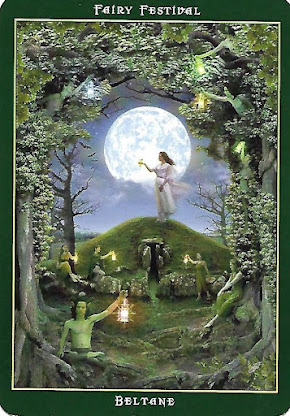
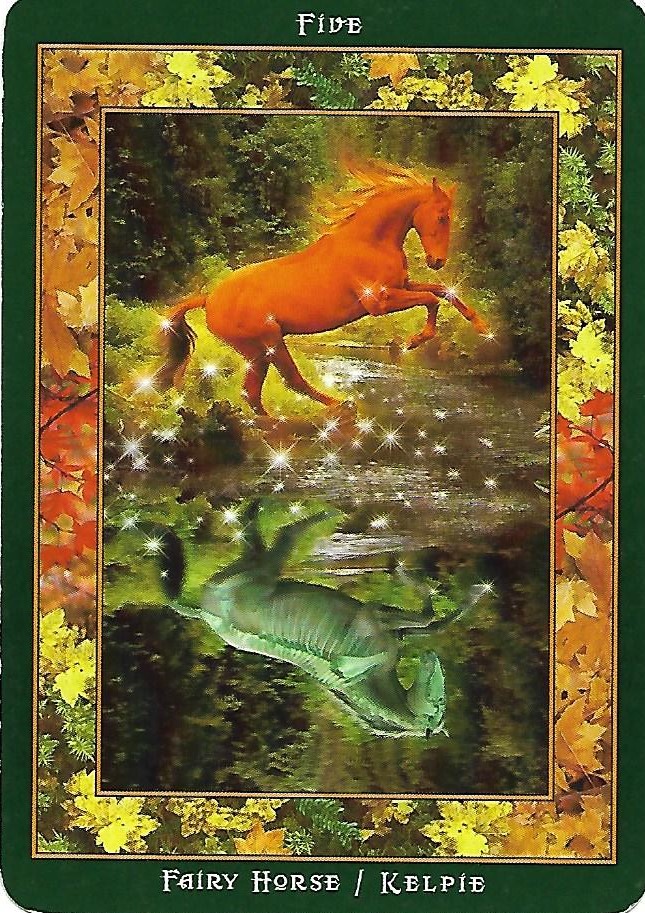
I shuffle and cut my cards in the usual manner, while posing the question about connecting with the Fairy World.  When I feel that I have shuffled enough, I turn the deck over so that I am viewing the picture side of the cards.  I then thumb my way through the deck until I come to the Beltane card, and then I pull that card, as well as the ones just before and after it.  The three-card spread that I get out of this does not offhand look auspicious for me, so it’s going to take some thought as to how to interpret this.  The cards are 1) the Phooka, 2) the Beltane card reversed, and 3) the Fairy Horse/Kelpie.

So, the first notable thing here is that the Beltane card is reversed, indicating that I’m not fully able to express and appreciate the celebrational energies of this season.  (OK, I can accept that, because recent surgeries have prevented me from getting out on long walks, as well as doing much-needed yard work; I genuinely enjoy yard work as a way of being in Nature.)  To amplify the Beltane magic, I could do something proactive, like go out and gather some blossoms.  Maybe I can find a watery ditch where the Marsh Marigold, (known as “the Flower of Beltane”) grows, and scramble down to collect a few petals for prosperity magic.
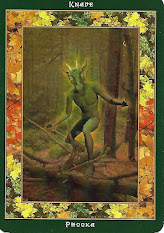
As the flanking cards are both edged with autumnal foliage, we see that those fairies are among those that the Fairy Ring assigns to “The Autumn Court.”  This could indicate being under the influence of issues and events dating from autumn, or issues relating to the autumn of life.

The Phooka card depicts a trickster fairy, best known for its shape-shifting abilities, so it could denote unexpected setbacks.  To turn this around into something positive, I’ll need to think about how I can utilize shape-shifting energies for personal regeneration, perhaps by observing the springtime Earth’s powers of metamorphosis.

The Fairy Horse, also known as the Kelpie, is also a shapeshifting trickster, (and sometimes the Phooka takes the shape of a horse), so this doubles the shapeshifting trickster implications of this reading.  Note that the reversed side of this card features the darker, more dangerous aspect of the horse, but as my card was upright, it would indicate that I won’t be seeing the worst side of him.  Also, Anna Franklin’s own divinatory meaning for this card is positive, suggesting that “He is the harbinger of good health, vitality, energy, and innovation.”  So that is energizing—even if a wild ride that brings its own set of challenges.  

Well, that’s my own Beltane reading, but I present it here to illustrate how you can utilize the card-search technique when you have an oracle deck that features different festivals or seasons.  Obviously, this same technique applies to the seven other Fairy Festival cards.  In this way, the Fairy Ring Oracle is useful in helping you align yourself with the Fairy World as it manifests in the cycle of the seasons.

Saturday, May 4, 2013

FAIRY MAGIC FOR BELTANE


Hi all!  I will be back at the Triple Goddess tomorrow to demonstrate some uses for fairy cards, in honor of the great fairy festival of Beltane.  In the meantime, I’ve been thinking about ways that we can enjoy a good relationship with the fairy folk.

When we look at the role the fairies play in so many different cultural traditions, we see that the fairies’ activities raise the vital energy that enlivens the universe.  Or maybe I should say, “multiverse.”  Actually, I like the Buddhist convention of talking in terms of “the ten thousand world systems.”  When viewed from that perspective, there can also be many different types of fairy realms, and other realms that can feel the influence of fairy magic.
 
So, if so much of fairy magic is spreading well being, what can we do to generate some good energy to keep the fairies going?  Well, traditionally, some of the most basic things are 1) acknowledging the fairies and their good work through greetings and ritual, 2) setting out suitable offerings, 3) creating beauty--as beautiful words, gestures, things, and places give fairies delight, and 4) engaging in celebrational activities, because festive energies revitalize fairy life.  Of course, in planning your celebrations, be sure to acknowledge the fairies by inviting their participation, set out foodstuffs such as miniature sweets or pour libations in their honor, and be creative about ways to bring beauty and grace into the festivities.

Of course, working with the different fairy decks is another way of acknowledging fairies.  So, now I have something personal to relate.  After drafting the above three paragraphs, I got up to read some fairy cards for myself, as I am about to go out on a walk, and wanted something to muse over, as well as some fairy companions to accompany me.  Well, seconds after pulling cards from assorted decks—and I’m talking seconds, because I don’t think even a minute had passed—I found my little gold mano cornuta necklace & pendant, which I have been looking for for two weeks, and had given up for lost, figuring it had fallen off during one of my walks.  I think the little folk are trying to tell me something, in affirming their existence.  Incidentally, some of the cards I drew were the Brownie from the Mason-Franklin “Fairy Ring” deck, and “Gawtcha,” a fairy type that catches you unawares, from the Froud “Faeries Oracle.”   So, one of my errands today will be to buy a fancy cupcake to set out as an offering, since fairy magic should always be acknowledged with gratitude.

Wednesday, April 27, 2011

Faeries and Flowering on May 1st

This Sunday is May 1st, popularly known as May Day or Beltane. Because it is the first Sunday of the month, I will be back at the Triple Goddess from 1 p.m. to 3 p.m. Because Beltane is a big day for the powers of Faerie, I will be demonstrating techniques using various faery oracle cards, and ways that we can relate to our faery friends. As with all of my “magical chats,” even if you came out for previous sessions, feel free to come back, because the cards are always leading us to new discoveries.

The other theme for the day is “the magic of flowering,” as May is a month when the woodland wildflowers, as well as many of our favorite garden flowers, are at their prime, plus the time around May 1st is the Floralia celebration honoring the goddess of flowers. Some people may think that a goddess of flowers would be kind of frivolous, and something of an afterthought in pagan religion, but this is not the case, as this was one of the Romans’ most ancient festivals, and they took this six-day festival quite seriously. According to E. O. James, “there is every indication that it began as a rustic feast connected perhaps with Aphrodite as the goddess of flowering plants (Antheia), held at the appropriate season at the end of April” [170].

Floral imagery is used extensively in the RWS versions of the tarot. In psychological symbolism, flowers can represent processes of growth within the psyche. For example, in discussing the fairy tale “Jorinda and Joringel,” Jungian analyst Sibylle Birkhauser-Oeri discusses how the hero dreams of a blood-red flower which provides a solution to his problem, explaining, “The flower thus represents a natural process of growth which takes place somewhere in the psyche without the conscious mind initially being aware of it” [“The Mother” 54]. In folk magic, (particularly in Mexican and South American shamanism), the idea of flowering relates to manifesting good luck. So, we shall also do tarot readings to discover areas of life where we can experience the magic of flowering.

By the way, I was going through Arthur Edward Waite’s book, “The Pictorial Key to the Tarot,” to see what he says about floral symbolism, when I glanced at his write-up on The Empress card, and saw something related to the magic of opening as discussed in the previous post, but also ties in with the current topic: “In another order of ideas, the card of the Empress signifies the door or gate by which an entrance is obtained into this life, as into the Garden of Venus … ” [83].

Now, I’m sorry to have to announce that there will be no Triple Goddess session for the month of June, because I am going to have to make a trip to California to attend to some family concerns. However, if the plan should change, I will announce that here.

Sunday, April 25, 2010

Faeries into Poetry

Looking forward to next Sunday, May 2nd. In honor of Beltane, a time when the energies of the Faery World are amplified, I will demonstrate different types of readings with Faery Oracle cards. Because the Frouds have just released a new deck, the “Heart of Faery” Oracle, these cards will be included among the others passed out as Faery Friends talismans to take home. However, as this deck is so new, I’m still in the process of familiarizing myself with it.

To help get to know this deck, I’ve been using it in bibliomantic experiments. For example, last night I went to hear the poet Diane Wakoski read from her new work, “The Diamond Dog,” at the Triple Goddess. To help get attuned, I was going through some of her other poetry books, and because she is known for her deep imagery, where the juxtaposition of striking images provokes striking insights and sensations, I got the notion to insert Faery cards into the books, and then consider how the Faery imagery and card meanings might provoke additional insights.

So, to demonstrate the technique for this blogpost, I have just shuffled and inserted random cards into random pages of “The Diamond Dog.” Among these, I find card 38 between pages 42 and 43 of The Diamond Dog. The card features a boyish sprite with silvery opalescent wings and a silvery opalescent glow; he flies by an ancient tree whose twisted form shines silver-gray in the moonlight. A little golden door at the base of the tree features Dagaz, the Day-rune, which some notable runelorists say can serve as a portal into other dimensions. Meanwhile, goblin faces take shape in the folds of the tree. This card is titled, “The Pan,” with reference to the immortal boy. Glancing at the two poems on these pages, I notice that in “The Secret of the Ring” on page 43, the poetess speaks of glancing at her “old hands,” which, “seem ringless except in owl-light, when Silver Boy points to the stone set in an invisible band on my marriage finger.” Aside from the obvious image of the silver boy, one can see a correspondence with the old hands and the gnarled tree, which then suggests a correspondence between the envisioned diamond on the ring finger and the jewel-like door in the tree.

Incidentally, in last night’s conversation with Diane, I mentioned that I enjoy her works because of her material imagery, including sensual images of things like fruits and gemstones, because for me as an Asperger’s person, it’s easy to relate to things, but difficult to get into concepts, except that material things provide me the entryway into deeper concepts. Diane replied that things serve as the entryway for her, too.

Continuing to consider the resonance between the card and the poem, I see that in the Wendy Froud write-up for the manual, she mentions how the Pan sees life and death as “an awfully big adventure.” This is a reference to the book “Peter Pan,” where, at a certain point, Peter thinks he’s going to die, and tells himself, “Death will be such an awfully big adventure!” Applied to this poem, this isn’t necessarily a portent of death--though of course, we’re all headed in that direction, and the older you get, the more you’re reminded of that fact. Rather, I think it says something about an artist’s mindfulness of death, as in the Heinrich Böll quote cited in a recent post, that, “The artist carries Death within him, like a good priest his breviary.”

Well, I could go on and on about the other poem-card image associations I have in front of me, but the silver boy image is especially serendipitous. This technique of making associations between cards and texts could actually work with any pack of cards, (even ordinary playing cards), and any book, (even the dictionary or phone book).