Saturday, January 1, 2022

OPENING THE DOOR TO THE MAGICAL HOUSE OF 2022

To start the new year auspiciously, I have once again consulted the Dollhouse Oracle.  Using the cardboard three-dimensional pop-out Victorian Doll House and the Victorian Fairy Tarot deck, which works very well with the design of the dollhouse, I posed the question, “Please show me what’s new in the House of 2022.”  (Note, the Victorian Fairy deck is the creation of Lunea Weatherstone and Gary A. Lippincott, and the Victorian Doll House is designed by Willabel L. Tong and illustrated by Phil Wilson.)

Although the Dollhouse Oracle can be performed at any time to take a fanciful walk through the metaphorical House of Your Life, I was thinking about the occasions one can perform the Dollhouse Oracle as a way of looking into the year ahead--as, due to different cultures’ having different dates for the start of the year, there are multiple times within a year to celebrate new beginnings.  As the ancient Celtic New Year began on Halloween, (Samhain), last Halloween, I entertained friends with another dollhouse popout, known as “The Witches’ Scary House,” (by Ib Bellew, Mick Wells, Ian Honeybone, and John Lupton).  The idea is to confront the things that can scare you in the year ahead.  Though meant for the strong of mind and spirit, it is done in a light-hearted way—as a way of taming your fears by better preparing for them.

Because in astrology, your birthday is your solar return, (when your sun returns to the degree it was in on the day you were born), your birthday is your personal astrological New Year, so a good occasion to do a divination for the year ahead of you.  Therefore, I’m thinking to do the oracle on my birthday as a way of looking at my very personal issues as they manifest throughout the year, but doing the New Years’ Day divination as a way of looking at what is in store for myself in relation to what’s going on in the world at large in 2022.

So, after shuffling and cutting the cards, the first card goes into the first room, which is the entry hall.  This position relates to your linking to the outside world, as well as what is entering your life.  In this way, it pertains to who or what is coming in, as well as to your ability to go out and about.  In this case, I got the “The King of Summer,” which in this fairy deck corresponds to the King of Cups.  This card traditionally denotes a gentleman who is jovial and presides over celebrations, but can also be given to excess.  This suggests that despite the current rise in COVID cases, we may all soon have something to go out and celebrate, (though there is also the potential of overdoing it, as some of us may get careless when we are finally able to get back out into the world again).  It is also significant that the first card is a King, as kings denote being in charge, and they can also denote the appearance of people who have the power to help us.

The King of Cups/ King of Summer in this front entry position also made me think about the old New Year’s tradition of first-footing, as well as various New Years’ traditions of opening the door to let in the New Year.

I think that opening the door first thing in the morning on any day is a deeply meaningful spiritual practice, as well as a magical act.   However, in many countries, there is a tradition of opening the front door to welcome the New Year.  (Some also open the back door to let out the Old Year). 

First-footing is a tradition which was especially prevalent in Scotland, though variations of the practice are known in other parts of Europe.  The belief was that the first person, (other than household members and other persons already present), to enter your house after the hour of midnight on the new year should be someone auspicious, because the nature of the person would determine the nature of your luck for the year ahead.  Many people made it a practice of arranging with a luck-bringing person in advance.  Due to cultural prejudice, this should always be a man.  This person should also bring a symbolic gift symbolizing prosperity, such as a coin or a loaf of bread, as it would be inauspicious to come empty-handed.  Certainly the King of Cups is one of the more auspicious tarot characters to come through your door.  Interestingly, because in this deck he is called the King of Summer, this could denote more summer-like conditions coming for what (at least in my state of Michigan) has been a particularly chilly winter.  However, I do recall a year when it got so warm, that I was gardening in shirt-sleeves in February.  Otherwise, it may be a metaphorical summer, as in a time of warmth and pleasure.

When a tarot card portraying an archetypal character appears in the entry of the Dollhouse Oracle, it is good to make a suitable greeting.  Here, I could say, “I welcome the King of the Year into the House of My Life.  May it be a bright year, a bold year, a golden year, a year of magic!”  (This last line I’ve adapted from my “Candle Spell to Welcome the New Year” in my book “By Candlelight: Rights for Celebration, Blessing, and Prayer.”)

Another thing: the King of Summer in this position suggests the archetypal battle between the Summer King and the Winter King, which relates to Celtic legend, and is enacted in European folk festival pageants, where the avatar of Winter is defeated by the avatar of Summer at the time of winter solstice, when the year wheel turns and the days begin to lengthen.  The Summer King then reigns until the summer solstice, when he, in turn, is defeated, and the days begin to shorten.  If we associate the eight cards in the eight rooms of the house to the quarter and cross-quarter days of the folk calendar, the entryway would link to the winter solstice, because, (before various historical calendar adjustments), the winter solstice used to fall on January 1st.

Now, as I am pressed for time, I shall continue the tour of the House of 2022 in an upcoming post.

Sunday, January 3, 2021

TAROT SPELL FOR BLESSING THE YEAR 2021

Using magical numerology and tarot, we find that each year corresponds to a tarot card or cards.  In the case of 2021, we have 2 + 0 + 2 + 1, which = 5, the number of The Hierophant card.  Additionally, because many of us pronounce 2021 as “Twenty Twenty-One,” this also corresponds to the Judgement card plus The World cards.  With all of these cards in mind, we can do a little tarot spell to help us focus on positive images for the year ahead.  While it is obviously too late to perform this spell on New Year’s Eve or New Year’s Day, it can actually be performed at any time on any day in this new year 2021.

But first, a few words about the cards:  In modern decks, the Major Arcana’s card Number 5 is more frequently called The Hierophant, while in older decks, it was called The Pope.  Historically, the hierophant was a priest who explained the Mysteries, and who was chosen for the beauty of his voice.  Some alternative decks have labeled this card The High Priest, The Teacher, Guidance, Faith, and Knowledge.  This card generally pertains to instruction, including knowledge passed down through religious authorities and cultural traditions.  Card no. 20, variously spelled Judgment or Judgement, is about awakening, and has also been labeled Karma, Beyond Illusion, The Aeon, Phoenix, Rebirth, and Transcendence in some alternative decks.  Card No 21, The World, is about wholeness, and has been relabeled by some as Ascension, Completion, Psyche, and The World Tree.  Taken as a grouping, these cards make a statement about expanding one’s consciousness and striving for wholeness in the process of learning and teaching.

In the tarot spell below, I illustrate the layout with cards from the Gaian tarot by Joanna Powell Colbert, which labels The Hierophant as The Teacher, Judgement as Awakening, and The World as Gaia.

To perform the spell, first lay down The Hierophant, while saying:

                The Year Twenty and Twenty-One:

                A year of teaching, a year of learning.

 Then place Judgment and The World in the positions as indicated in the illustration above, (creating a pyramidal layout), while saying:

                 So may we awaken to a World of Blessing,

                on the path of learning, on the path of teaching.

Then, give yourself some time to contemplate the cards’ associations and imagery while thinking about ways that you can open yourself to new knowledge--especially in the service of world healing and wholeness.  You may even create some new teaching traditions to pass along.

(Note: Consider how the year 2021 gives us this meaningful combination. It won't work for 2022, because the Major Arcana only goes up to 21.)

Friday, January 1, 2021

TAROT FOR THE NEW YEAR 2021: A WORLD TURNED UPSIDE DOWN

Last night, which was New Year’s Eve of 2021, I did a reading to learn the general quality of the year ahead for society at large, and the central, focal card was “The World” reversed.

Actually, the card was “The Worlds” with an “s” on the end, because I was using The Victorian Fairy Deck, and this deck uses Worlds plural, indicating the interpenetrating realms of the human and fairies, the wild and the domestic, the material and the imaginative, etc.

I used the Victorian Fairy deck because I had received it as a Christmas present, so it seemed appropriate to use my newest acquisition.  Through different eras, our cultural imagination has perceived the fairy folk differently, and so portrayed them differently in art and literature.  As it has been jokingly said that the Victorians liked to imagine fairies as ordinary Victorians with wings on them, the creators of this deck, (Lunaea Weatherstone, with illustrator Gary A. Lippincott), have taken up this idea for the images.  In the case of “The Worlds” card, we see a ring of fairies in Victorian costume, dancing in a clearing in the woods.  However, the towers of a city are shown off in the distance, conveying the idea of connected world systems.

I interpret this reversed Worlds card as a caution that things won’t get back to normal all too quickly, due to COVID and other social upheavals, including the transition to a new presidency.  Among other things, it might take longer for vaccines to turn the situation around, and/or for the transfer of political power to be effective.

This New Year’s Eve reading was done as a three-card spread, where the flanking cards were The Queen of Autumn and The Herald of Spring.  (In this deck, Autumn corresponds to Pentacles, and Spring to Wands.)  Both were upright, so in their full expression.  One can put different lenses on a three-card spread, so if viewed as something of a timeline, the old lady Autumn comes before the young fellow Spring, which also suggests a certain reversal of the natural order.  In practical terms, however, the Queen of Autumn might indicate that society at large has the resources and experience to manage the world situation, and the Herald of Spring might denote the breath of fresh air we’ll be feeling when we get some good news and the world opens up again, so we can go out and enjoy ourselves.

By the way, in reference to my previous post on The Dollhouse Oracle and the House of 2020, I did a reading for myself this morning, to see what the House of 2021 will look like for me.  I again used The Victorian Fairy Deck, and I also used the Victorian House pop-up book, and found the color scheme of the cards worked very well with the color scheme of the house.  Color scheme is not a big deal, but I do appreciate harmonious graphic relationships.  (Note—Last year I used the Edwardian House by Brian & Lizzie Sanders as authors, and designed by Suzanne Ferguson; the Victorian House was designed by Willabel L. Tong and illustrated by Phil Wilson.)  Two cards came up that do suggest the ongoing COVID situation:  for the entryway, I got the reversed Chariot, which suggests staying inside, and in the upstairs hallway, denoting one’s ability to get around, I got The Hermit—again indicating the need to self-isolate.  I don't know whether these cards foretell a worsening COVID situation and therefore a greater need to stay at home, or just the fact that I have the privilege of being able to work from home.

Wednesday, December 30, 2020

THE DOLLHOUSE ORACLE AND THE DEATH CARD IN 2020

Greetings to whoever may still be following this badly neglected blog—along with my apologies for not having attended to it in several years! 

As my day job is such that I can do most of my work from home during this COVID crisis, I had hoped that not having the daily commute would free up some time for writing, but it has not worked out that way.  Unfortunately, also, I haven’t been able to hold my monthly Tarot Magic Adventures sessions at The Triple Goddess, as it would not be possible to maintain social distancing.

Because we are on the verge of a new year, I want to demonstrate how The Dollhouse Oracle can be used to foretell the quality of the year ahead, by sharing some insights into a reading I did for myself on New Year’s Day of 2020.  Normally, I don’t bore people with the details of my personal life, but the 2020 reading was significant because it made associations with what was happening in my life in relation to larger society and the effects of the COVID pandemic, (especially since one of the cards that came up was the Death card).

But first to explain the technique: the Dollhouse Oracle is a technique that I invented, and it uses a pop-up cardboard dollhouse to serve as a layout for a tarot spread: you insert tarot cards into different rooms, and then consider the traditional meanings and graphic associations of the cards in relation to the symbolism of the rooms of a house, which serve as metaphors for different areas of one’s life.  You can pose a question like, “Please show me what’s going on in the house of my life,” or “what will be going on” if you want to peek into the future, or “what was going on” if you want to contemplate the past.  (To learn more about how to do a Dollhouse reading, refer to my online Llewellyn article at https://www.llewellyn.com/journal/article/2044, or google the words “Dollhouse Oracle” to find your way to the article; also, refer to my posts for May 29, 2012 and June 9, 2013.)

So, when it occurred to me that you can use this technique for a New Year’s reading, I requested that the cards show me what would be going on in the “House of 2020.”  (Also, I was using the Gaian Tarot by Joanna Powell Colbert, which is an alternative deck that uses what might be described as old hippie lifestyle images, and uses elements like Fire and Water for the suits, instead of Wands and Cups.)  Some of the cards that came up in association with different rooms were more striking than others, and some became more significant in light of the pandemic.

I drew the Death card for the upper hallway, and I use the hallway to signify one’s ability to get around in life, and how smoothly one can move between the different compartments of one’s life.  When I pulled this card, I was necessarily concerned because I do have some elderly relatives with health problems—though of course, the Death card generally doesn’t mean someone’s physical death, but the end of some matter or way of living.  Fortunately, I haven’t lost any relatives, and in retrospect, I relate the Death card to COVID itself, which has affected the way that all of us are able to get around.  Even if we and our loved ones haven’t suffered the disease itself, we are still prevented from doing certain things and going places, and are having to make major lifestyle adjustments.  Indeed, in the Gaian deck, this card is illustrated with an old, derelict boat, which is decaying alongside the shore—so nobody’s getting around in that.  In more traditional tarot decks, the Death card features the Grim Reaper, and one can see COVID itself as a specter that roams the land, just as the Grim Reaper does in medieval paintings and woodcuts.

Another card that made more sense in the light of COVID came up for the kitchen, where I got “The Gardener,” (usually called The Empress).  This card features an illustration of an Earth-mother figure surrounded by fruits and vegetables, and I initially thought it made a statement about the need for good nutrition.  However, I must confess that I did get in on the panic shopping, and stocked up so well that I am still eating my way through my survival pantry.  (I did buy a good deal of vegetable oil and pre-cooked bacon, because I figured that if I were reduced to eating the dandelion greens in my yard, I at least wanted to make a tasty salad of them.)

In the dining room, I got the “Elder of Water,” which would be the King of Cups in a regular deck.  I couldn’t figure out what this denoted, until I realized I’m doing my most of my work from home by sitting with my laptop at my dining room table, and the Elder/King thus represents the authority of my good-guy boss, who is a Pisces, and who authorized me to do most of my work from home.

For the bedroom, I got the Nine of Fire, which corresponds to the Nine of Wands.  Normally, this could denote multiple choices of projects and enterprises, (so not something one associates with bedrooms).  However, the Gaian deck illustrates this card with a man whose chakras are lit up as he sits in meditation, and in fact, because I have a revived interest in altered states of consciousness, I take a daily break for meditation in my bedroom (on those days when I’m working from home).

In the bathroom, which deals with bodily concerns and issues around purification, I drew the Seven of Water, in which illustration a man is surrounded by a number of fancy blue vessels, and is chug-a-lugging the contents of one of them.  I believe this points to a chronic sinus condition that I have, but didn’t give much thought to until my place of employment started requiring me to do daily health checks before letting me through the door.  In an attempt at healing, I have been using neti pots, supplements, and other home remedies—though I haven’t been the best at sticking to a good regimen.  It is concerning, because it’s a pre-existing condition that could make for a bad outcome if I got sick.

 Of course, not everything in my reading can be related to COVID.  I’m happy to say that in the nursery, which can represent one’s future hopes, I got the “Ten of Earth.”  This is the Ten of Pentacles in a regular deck, and is often illustrated with an intergenerational family group, and can designate traditions and other values that are passed down through families.  In the Gaian deck, it shows a man following a forest path, so the imagery isn’t too remarkable, but the card itself is significant in view of the fact that this year my first grandchild was born, so there is indeed a new generation, and new values and traditions to be passed down.  (I spent my summer vacation helping with the new arrival.)

That leaves two other rooms.  In the front entryway, I got the Ace of Water, which can denote new emotional experiences; as the entryway does signify how we open ourselves up to new things, there is some resonance between the meaning of the room and the meaning of the card—plus dealing with a pandemic and having a grandchild are new emotional experiences.  The other card was the Two of Fire (Wands) for the living room, which is about lifestyle and life choices.  I don’t have any especially relevant insights about that one.

I could say much more about the interrelation of symbolism between the rooms and the cards, and how these things have been manifesting in my life, (and also in our public life, in the way that tarot readings have a holographic quality).  However, those are the highlights, and give you an idea of how insightful this technique can be. 

2020 isn’t over yet, so I continue to be mindful of what the cards may be trying to say to me.  It will be interesting to see what comes up for the House of 2021.


Tuesday, January 1, 2019

A RITE FOR AFFIRMING HEALING


Happy New Year, everyone!  I am happy that I finally have had a little vacation time to get back to writing.  Having undergone a recent illness, I have been reflecting on cross cultural ways of celebrating healing—something which ties in with the theme of New Year as a time for renewal.

Unfortunately, Western medicine doesn’t draw a clear line between the state of being sick and the state of being healed.  For the more common and curable types of illness, you just take your medicine and expect that at some point your symptoms will have subsided enough for you to get back on your feet.  By contrast, many traditional societies affirm a person’s return to health with special rituals.  For example, a person might take a ritual bath, put on a new set of clothes, and go to a shaman to be blessed.  In Mexico and South America, the shaman’s proclamation of healing may be followed by a “flowering” ritual to generate good luck, (as luck is viewed as part of a state of health).  In keeping with the idea that our community helps to construct our identity, the public is often invited to a communal feast as a part of these rituals. 

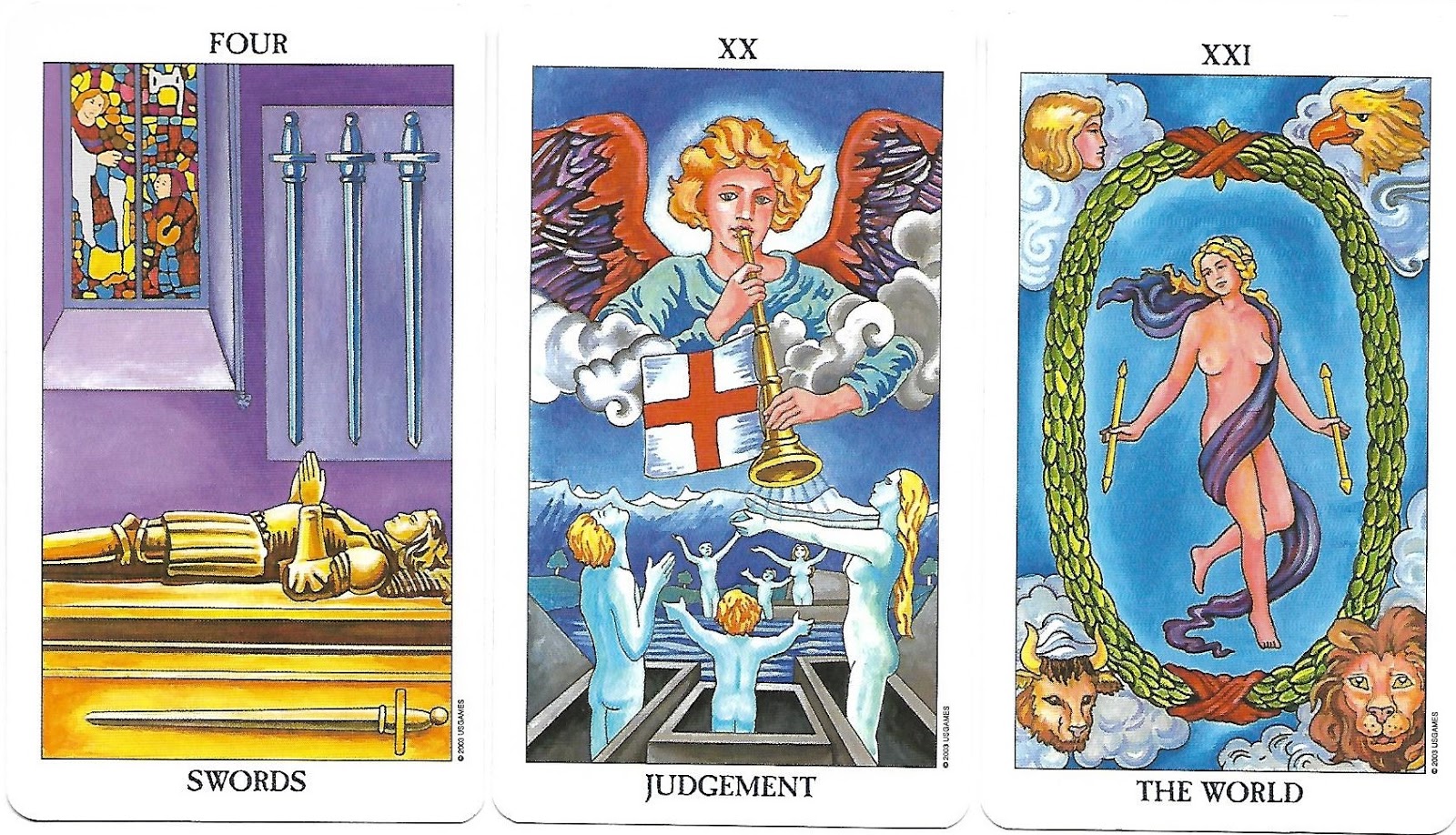
Although it might be a bit much for people in our busy society to stage a public celebration of healing, this is something that can be quietly affirmed with a simple tarot rite.  The following rite, (here illustrated with the “Radiant Rider-Waite Tarot”), uses images of recuperation and revival, as a way of signaling your Unconscious that you are ready to reengage with your life.


To affirm your recovery, first lay down the Four of Swords, (featuring a tomb with the effigy of a recumbent knight) while recalling how your illness may have knocked you flat, enforcing isolation and inactivity. Next, lay down the Judgment card, whose images of arising can suggest a return to health after sickness—especially as a long illness is sometimes experienced as a stay in the Underworld.  Think about how much better and more energetic you’re feeling, and then lay down The World card while thinking about how you are back on your feet and reconnecting with your outer world.

By the way, it’s always interesting to look at graphic relationships between cards in a rite or spell.  Using the “Radiant” Rider Waite Smith cards as illustrated above, the first and second cards feature images of tombs—contrasting the sealed tomb with the open tomb.  There is also a contrast between the human bodies portrayed.  In Judgment, the rising people are a bluish tinge, still retaining the coldness of the tomb, while The World is used here to show a person restored to the ruddy pink of active health.  (The original RWS deck doesn’t bring out the same nuances in coloring.)

Note that because magic involves affirming a desired state of being as if already achieved, you can also use this layout as a tarot spell to promote healing for yourself or others still convalescing.  If performing this spell for a child, use The Sun as the third card, as The Sun card often features the image of a happy, healthy child having fun under the sun, (with flowers in the background hinting at the quality of flowering). 

If preferred, you could also use The Sun for yourself or another adult, in lieu of The World.  This begs the question, why not use The Sun and The World, as both are auspicious cards with images of health?  The reason for preferring a three to a four-card spread is that odd numbers show activity, while even numbers promote stability, and are therefore more gravid.  So, for restoration of health, we want to put the emphasis on the return to activity.

So, now that I’m back to my blog after such a long hiatus (due to the demands of holding down a regular job), I will next have to get around to restoring all my dead links.

Sunday, February 7, 2016

FEBRUARY IS FOR SECOND CHANCES

If you have missed out on something or gotten off to a bad start for this year 2016, remember the slogan, “Today is the first day of the rest of your life.”  Although I don’t think I’ve heard this expression since I was a kid in the Sixties, it was a popular subject for posters and bumper stickers.  I seem to recall it set in psychedelic prints, but maybe that’s just a reconstructed memory.  Since then, the computer era has brought new image associations for starting over: rebooting your day/ week/ month/ year/ life, or hitting the re-set button.

For those of the magical mindset, the calendar brings many additional opportunities for a fresh start, considering that the year is a wheel, and a wheel has no single, separate starting point, but 360 (or 365) starting points.  So, if January 1st is a big day for starting the year out on the right foot with New Year’s resolutions, January 2nd should be honored as a day of second chances for those of us who messed up, or who were too busy or forgetful to get it right and make it auspicious on January 1st.  Likewise the second day of every week and month.  As the second month of the year, February can be a particularly good month for setting a new agenda—especially as Chinese New Year most often falls around the beginning of February.  Of course, if we look at different world cultures, both past and present, we find the new year has also been celebrated at spring equinox, April 1st, Beltane (May Day), Samhain (Halloween), Yule, and on other days besides.

As it happens, this year Chinese New Year starts tomorrow, as it falls on February 8th, and is a fire monkey year.  Though not of Asian ancestry, I am looking forward to this as a second chance, because my new year got off to a really bad start, as I awoke on January 1st with a nasty cold that turned into bronchitis.  Furthermore, I am a fire monkey about to turn 60, having been born in March of 1956.  The sexagenary year is significant to the Chinese zodiac as the completion of a cycle and the beginning of a new cycle, as there are 12 animals and 5 elements, so 12 x 5 = 60.

Even if you weren’t born in a monkey year, you can still use the monkey as a lucky charm for 2016, as each year’s animal icon is auspicious for that year.  Following is a little bit of my past research on monkeys and charm lore:

Monkey:  Monkeys are about having fun, going wild, and letting out the playfully curious animal within.  (Think about Curious George.)  There is some dualistic symbolism here: cynical people use the image of the ape to mock human pretensions, while for others, it celebrates our close kinship with the animal world.
When used as a charm image in Asia, the monkey can promote the qualities of vitality and enthusiasm, (especially for persons born in the Chinese Zodiac Year of the Monkey, including the years 1920, 32, 44, 56, 68, 80, 92, 2004, 2016, 28, 40, 52 …), or invoke the strength and protection of the god Hanuman, whose army of monkeys defeated the forces of evil.  In Asian folk art, a well known trio of “three wise monkeys” conveys the injunction to see no evil, hear no evil, and speak no evil.  In Japan, different monkey charms are associated with Shinto shrines and deities who grant wishes and bestow fertility, easy delivery, and a harmonious family life. Charm objects include a “wish monkey” on which people write their desires, and a “substitution monkey,” which takes on a person’s bad luck.  Because the Japanese word for monkey is very close to the word for “expel” or “drive away,” miniature monkeys are also used as charms to ward off negative influences and illness.  Japanese monkey charms are usually red for active luck, fertility, and protection.  A term popularized by Buddhism is “monkey mind,” referring to the restless mind’s tendency to jump from one thing to another.  You can use this knowledge to promote self-improvement—and when you are agitated and unfocused, you could pinch a monkey charm as a reminder to calm your thoughts.

So, if you feel your year got off to a bad start because you were monkeying around, think about how the Year of the Monkey might help you turn that into a positive.  Happy New Year!

Sunday, January 10, 2016

GAZING INTO THE PHOTOGRAPHIC UNCONSCIOUS

A Belated Happy New Year to All!  I hope that 2016 will bring you new ideas and adventures that keep your sense of curiosity piqued, because curiosity fuels vitality.  I am very dismayed to realize that I only made one blog-post in 2015.  Ever since I had to stop eking out an existence on the margins of society and get a “real job,” it’s been hard to find time for writing.  I hope this shocks me into greater productivity in 2016.

That being said, if your curious mind seeks new inspiration, you might want to explore the realm of the “Photographic Unconscious.”  This is a term used by the essayist Walter Benjamin, whose attention to the small things of everyday existence reveals ways in which our material world manifests elements of our collective dream worlds.  By the same token, the photograph can be a window into the world of the Unconscious, because it can capture image objects that give rise to chains of meaning beyond those perceived and intended by the photographer or the subjects photographed.  This is as true for staged photographic compositions as it is for candid snapshots.

At our last magical chat session (which was in November), the subject of the Photographic Unconscious came up in relation to ways you can read a photograph (or other arrangement of images) like a tarot card.  When a particular image—whether in a tarot card, a photograph, or whatever interior or exterior scene is before you—strikes  you as personally significant, your Unconscious is sending you a signal that this is something you should pay attention to, as carrying special meanings for you.  And when you are able to make additional associations between the symbols, you can appreciate what a wonderfully expansive inner life you have.

This concept also gives you a lot to work with if you are a photographer.  For a collection of photographic symbols that provokes new insights and associations, take a look at Brandy Eve Allen’s “Invisible Light Tarot Deck,” which is in the end process of development and will by available for purchase by February 1st.  You can learn more about this tarot deck, as well as Brandy’s work, at http://brandyeveallen.com/about/, and https://www.kickstarter.com/projects/brandolina/invisible-light-tarot-deck-by-brandy-eve-allen.

The images in this collection were generated with infrared photography, and as Allen says, “Similar to the way the tarot cards reveal that which is hidden, infrared film is picking up light that is invisible to the human eye.”  Among the photos that I find significant in this respect are those used in the Sun and Hermit cards, because of the stark contrasts between light and shadow.  So, all we can make out of the woman in the foreground of The Sun card is her figure in black, suggesting the philosophical observation that the brighter the light, the darker the shadow, (as well as the Jungian concept of the “bright shadow.”)  In the Hermit card, the pyramidal structure of the tent is dramatically illuminated, echoing old stories about the hermit as the one who shines a light in the wilderness, to point out the way that leads outward and upward.

Note that Allen also offers new images for the Minor Arcana cards, too, (which is always something to be appreciated), so The Invisible Light Tarot offers 78 compositions to challenge your ability to make new meanings.